
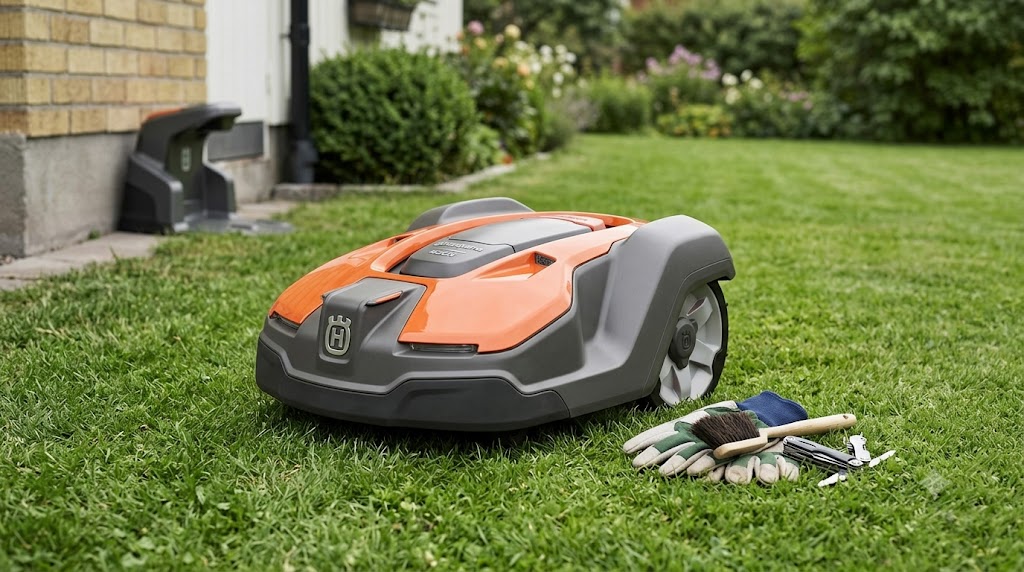
My uncle bought his first Automower back in 2019 and treated it exactly like he treated his old push mower. Ran it hard, wiped it down maybe once a season, and never touched the blades until they were basically flat metal discs. Three years in, his lawn started looking patchy in weird spots and the mower kept struggling on his slight incline. Turned out the blades were so worn they were tearing grass instead of cutting it, and the whole underside was caked in old clippings that never got cleaned out. A robotic mower doesn’t complain the way a gas mower does when something’s off. It just quietly does a worse job every week until you notice your lawn looks off.
That’s really the whole point of this guide. Automowers need less hands on care than a normal mower, but “less” doesn’t mean “none.” There’s a real rhythm to it, blades every couple months, a proper clean a few times a season, and a specific winter routine that protects the battery and the electronics for years down the line.
Quick answer: Husqvarna recommends replacing Automower blades roughly every 2 months during the mowing season, cleaning the mower and charging station regularly (with a deeper clean at season’s end), and storing everything indoors above freezing for winter after a full charge and thorough cleaning. Boundary and guide wires can stay in the ground year round.
Blade replacement, and why it’s not optional
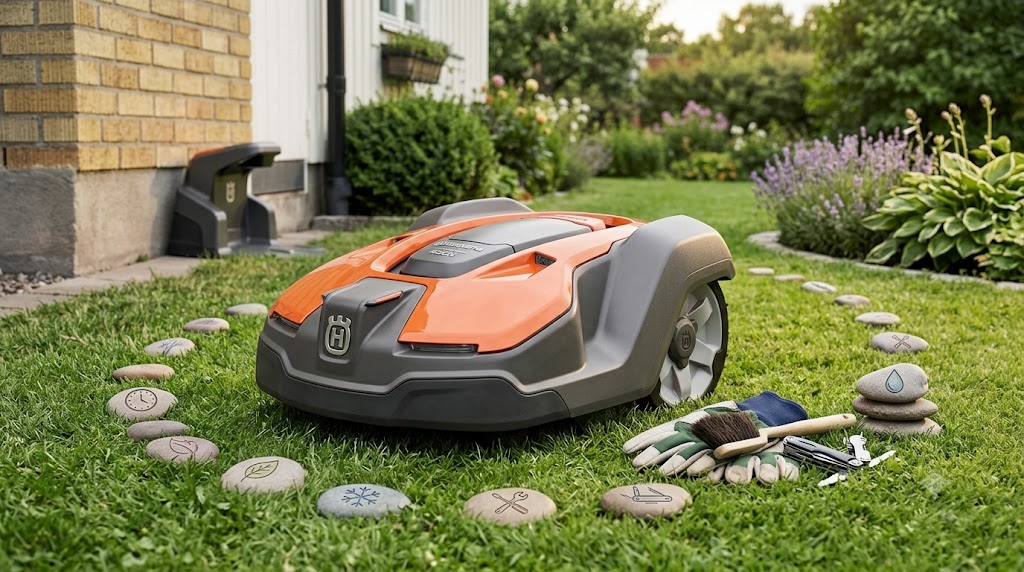
Husqvarna’s own support team puts it plainly. It is recommended to replace your blades every 2 months for optimal mowing results and low energy usage, and that number shifts depending on your grass type and yard size. Some sources give a slightly wider window of 6 to 8 weeks for the Long Life Safety Blades and 3 to 4 months for the Endurance Safety Blades, so check which blade type came with your model before you set a calendar reminder.
Here’s what actually happens when you skip this. Dull blades don’t cut grass cleanly, they tear it, and torn grass shows up as frayed or whitened tips across your lawn. Your mower also has to work harder to push through the grass, which means more battery drain and more charging cycles just to cover the same ground. If you’ve got gravel, sand, or a lot of roots in your yard, wear happens even faster, so don’t assume the 2 month mark applies evenly everywhere on your property.
One thing people miss constantly: always swap the screws along with the blades. They’re made to be replaced as a set, not separately, because mismatched wear throws the whole cutting disc out of balance.
If your model has the EdgeCut feature for trimming along borders, those blades last longer since they’re only active during edge passes, generally holding up for 9 to 12 weeks. Spring is the one season where you’ll want to check blades more often than usual too, since faster grass growth means more sap, and that sap builds up sticky residue on the blades that slows down clean cutting.
Cleaning your Automower without ruining it
This is the part where people accidentally cause damage while trying to help. Husqvarna is direct about it: never use a high pressure washer or solvents on the charging station, full stop. A handful of newer models (305 from 2020 onward, 310 Mark II, 315 Mark II, 405X, 415X) can handle running water like a garden hose on the mower body itself, but that’s the exception, not the rule. Check your specific model before you reach for the hose.
For the regular clean, here’s the actual routine straight from Husqvarna’s own guide. Turn the mower off first. Put gloves on, since the blades stay sharp even when the machine is powered down. Flip it onto its side or upside down and clear out chunks of clippings by hand, staying away from the blades themselves. Then take a brush to the skid plate, wheels, and body to get rid of what your hands couldn’t. A damp cloth with a bit of mild soap handles the chassis and outer panels.
The charging station gets its own quick pass too. Unplug the power supply first. Clear off any grass, leaves, or twigs sitting near the docking area, since that stuff can throw off the mower’s ability to align and charge properly. Wipe the surface down with a damp cloth, and check the contact plates. If they look dull or corroded, a fine grade emery cloth brings them back.
How often should this happen? There’s no single fixed number Husqvarna gives for casual home cleaning, since it depends on how much your mower is picking up week to week, but the general guidance is to do it regularly through the season and follow up with a proper deep clean before winter storage. A mower coated in clippings actually struggles on slopes, so if you’ve got any incline in your yard, don’t let debris pile up.
The maintenance schedule broken down by season
Spring startup: Check the blades from last season and swap them if they show wear. Inspect the wheels and lower bearings for anything loose or damaged. Give the mower a light clean if it sat indoors all winter, since dust does build up. Reconnect the charging station and confirm the wires are seated properly.
Through the mowing season: Replace blades and screws roughly every 2 months, adjusting for your grass type and how often the mower runs. Clean the mower and station on a rolling basis, more often if your yard has a lot of trees dropping debris. Keep an eye on the charging station LED, since a change in color is usually the first sign something needs attention before it becomes a bigger problem.
Fall prep: This is where you start slowing things down. Let your grass grow slightly longer before winter hits, somewhere around 6 to 8 cm, since longer grass actually protects the lawn better through cold weather. Book an annual service with your dealer if you’ve got one lined up, ideally before the season fully wraps.
Winter storage: Full battery charge, then power off completely. Deep clean the entire mower and the charging station, including the underside and blade disc. Store everything indoors somewhere dry and above freezing. Most current models don’t need periodic charging during storage, just make sure the battery was topped off before you shut it down. Some older models are the exception and need a top up every 3 months, so check your specific manual if your mower has some years on it.
What can stay outside and what has to come in
People assume everything needs to come indoors for winter, but that’s not quite right. The boundary wire and guide wire can stay installed in the ground the entire winter without any issue. If your model runs on EPOS technology instead of a physical wire, that reference station is weatherproof and built to sit outside year round too, rated to handle temperatures from negative 20 to positive 70 degrees Celsius.
The mower itself and the charging station power supply are a different story. Husqvarna strongly recommends bringing both of those indoors. If for some reason you can’t store the charging station inside, it needs to stay connected to power and to the wires through the whole winter rather than sitting disconnected and exposed. Rest the mower flat on all four wheels on a level surface, or use a proper wall hanger made for this exact purpose. Don’t just prop it against a wall or lean it somewhere awkward, since that puts pressure on parts that aren’t designed to carry weight that way.
A quick word on battery care specifically
The single most important step before storage is charging the battery all the way, then switching the main power off. This protects the battery’s overall health while it sits unused for months. It’s the opposite instinct of what people do with things like phones, where you might think a partial charge is safer for long term storage, but Automower batteries are built and recommended to go into hibernation fully charged.
The comparison worth understanding
| Task | How often | What happens if skipped |
|---|---|---|
| Blade and screw replacement | Every 2 months (season dependent) | Torn grass, higher battery drain, uneven cut |
| Routine cleaning (mower body) | Regularly through season | Poor slope handling, buildup around moving parts |
| Charging station cleaning | Regularly, more if trees nearby | Docking failures, misalignment |
| Deep clean and inspection | Once per season, before winter | Corrosion, worn parts going unnoticed |
| Full charge and power off | Before winter storage | Reduced battery lifespan |
| Professional dealer service | Once a year, ideally spring | Missed wear on parts you can’t easily inspect yourself |
Wrapping it up
The whole system really comes down to three habits. Change your blades on a schedule instead of waiting until the lawn looks bad, since by the time you notice patchy cutting the blades have already been dragging for weeks. Clean both the mower and the station on a rolling basis rather than letting debris pile up, especially before winter hits. And when the season ends, do the full shutdown properly, charge it up, clean it out, and store it somewhere dry and frost free.
If you’re setting up a new mower or troubleshooting a docking issue, our guide on charging station placement covers the setup side of things in more depth.
FAQ
How often should I replace Automower blades? Husqvarna recommends replacing blades and screws roughly every 2 months during active mowing season, though this can shift to 6 to 8 weeks or 3 to 4 months depending on which blade type your model uses and how tough your grass and soil conditions are.
Can I wash my Automower with a garden hose? Only if you own one of the specific models Husqvarna lists as compatible, including the 305 (2020 or later), 310 Mark II, 315 Mark II, 405X, or 415X. Every other model should be cleaned with a damp cloth and mild soap instead, never running water.
Can I pressure wash the charging station? No. Husqvarna is clear that a high pressure washer should never touch the charging station on any model, since it risks pushing water into the electronics.
Do I need to store the boundary wire indoors for winter? No, the boundary wire and guide wire can remain installed in the ground throughout winter without any issue.
Should the battery be charged or empty before winter storage? Fully charged. Charge the battery completely, then turn the main switch off before storing the mower for winter, since this protects the battery’s health during the months it sits unused.
How often does the charging station itself need cleaning? There’s no strict fixed interval, but Husqvarna recommends cleaning it regularly, clearing away grass, leaves, and twigs that build up near the docking area, since debris there can interfere with alignment and charging.
What temperature should I store my Automower at over winter? Store it indoors somewhere dry and above freezing point. If you’re using an EPOS reference station instead of a physical wire, that unit is weatherproof and rated for outdoor storage between negative 20 and 70 degrees Celsius.
Do I need to replace the screws when I change the blades? Yes. Husqvarna specifically notes that blades and screws should be replaced together to keep the cutting disc balanced, since mismatched wear between old screws and new blades throws off the balance.
How do I know my Automower blades need replacing before the 2 month mark? Watch for frayed or whitened grass tips after mowing, visible nicks or wear on the blade edges themselves, or a noticeably rougher cutting pattern than usual. Any of those signs mean it’s time to swap them out early, regardless of the calendar.
Is annual dealer servicing actually necessary if I do my own maintenance? It’s strongly recommended even if you’re diligent at home, mainly because a dealer can spot wear on parts like wheel bearings and internal components that are harder to inspect yourself. Scheduling it before spring keeps the mower ready to go right as the season starts.