
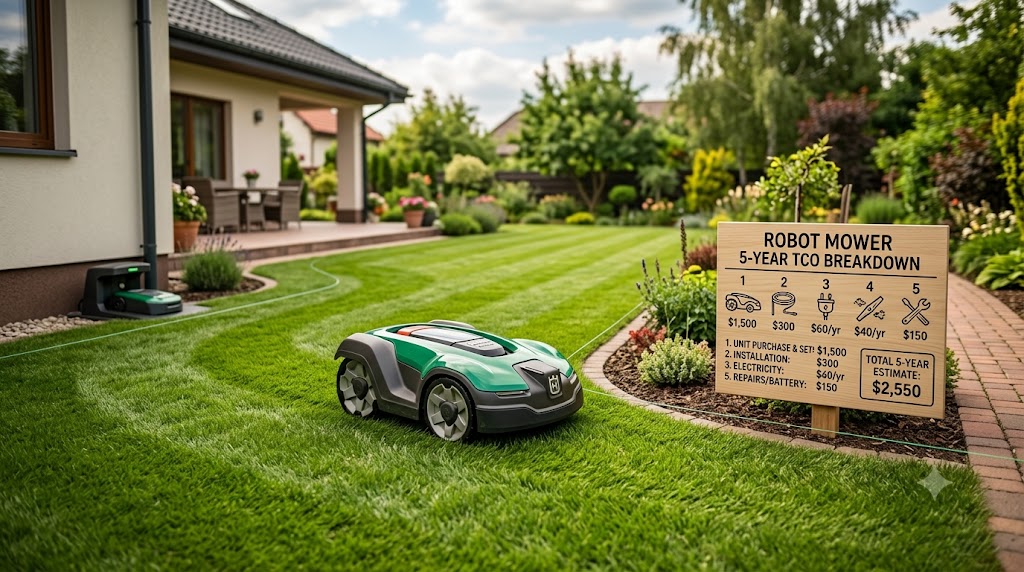
The sticker price on a robot mower is the easy part to compare. What actually decides whether it was a good buy shows up later: the blades you replace every couple of months, the battery that eventually needs swapping, and the electricity bill that barely moves. None of that gets mentioned on the box.
Short answer: Over 5 years, a mid-size wire-based robot mower typically costs somewhere between $2,500 and $4,500 total once you add the purchase price to blades, electricity, an eventual battery replacement, and occasional service, based on cost breakdowns published by mower retailers and manufacturers. That’s still meaningfully less than the 5-year cost of a gas push mower or riding mower once fuel, oil, and parts are factored in, according to a published cost comparison from robotic mower retailer Terramow.
Here’s where that number actually comes from, broken down by category.
The purchase price sets the floor
Entry-level wire-based robot mowers for small yards start around $500 to $700, mid-range models for yards up to an acre run $1,000 to $2,500, and GPS or RTK-equipped flagship models for larger or more complex lawns run $2,400 to $5,000 or more. Installation, if you hire it out instead of doing it yourself, typically adds another $200 to $500 depending on lawn complexity.
This purchase price is the single biggest line item in the 5-year total by far, which is why it’s worth matching the mower size to your actual lawn instead of buying more coverage than you need. A $2,000 mower rated for an acre on a quarter-acre lawn doesn’t mow any better, it just cost more up front.
Electricity: the cheapest part of the whole equation
Robot mowers charge themselves in short bursts throughout the day rather than running one long cycle, and the amount of power involved is small. Independent measurements put typical consumption at roughly 0.5 to 2 kWh per week during the mowing season, depending on lawn size and how often the mower runs.
At the U.S. Energy Information Administration’s forecast average residential rate of about 18 cents per kWh for 2026, that works out to somewhere between $15 and $40 a year for most residential-size mowers, or roughly $75 to $200 over 5 years. Compare that to the $150 to $250 many households spend annually on gasoline for a push mower, and the electricity side of the ledger isn’t close.
Blades: the recurring cost people forget to budget for
Robot mower blades are small, cheap, and meant to be swapped often rather than sharpened. Most manufacturers recommend changing them every 2 to 3 months during active mowing season, since dull blades tear grass instead of cutting it cleanly, which stresses the lawn over time.
A set of replacement blades typically costs $10 to $30 depending on the brand and blade type, and most owners go through 2 to 4 sets per season. That puts annual blade costs at roughly $20 to $90, or $100 to $450 over 5 years. It’s a small number individually, but it’s the one recurring cost you’ll actually think about every few months, unlike electricity, which just shows up quietly on the utility bill.
Battery replacement: the one big expense you can plan for
Lithium-ion batteries in robot mowers generally last 3 to 5 years before they lose enough capacity to noticeably shorten runtime. Replacement batteries run $100 to $400 depending on the mower’s voltage and capacity, with higher-end models toward the top of that range.
Over a 5-year ownership window, most owners should plan on one battery replacement, usually somewhere in year 3 or 4. That’s a single cost, but it’s large enough to plan for rather than get surprised by, especially if you’re comparing total ownership cost against a gas mower that doesn’t have an equivalent expense.
Maintenance and service: mostly optional, occasionally necessary
Compared to a gas mower, a robot mower skips oil changes, spark plugs, air filters, and fuel stabilizer entirely, since there’s no combustion engine to maintain. What’s left is mostly cleaning the underside of the deck and wheels, checking the boundary wire for breaks, and an occasional annual service if you want a dealer to inspect sensors and update software.
Professional annual servicing, when people choose to pay for it, generally runs over $100 per visit plus parts. Most DIY-minded owners skip formal servicing entirely and just handle blade changes and basic cleaning themselves, which keeps this category closer to $0 to $50 a year in practice. Budgeted conservatively across 5 years, that’s roughly $250 to $500 if you pay for occasional professional service, or close to nothing if you don’t.
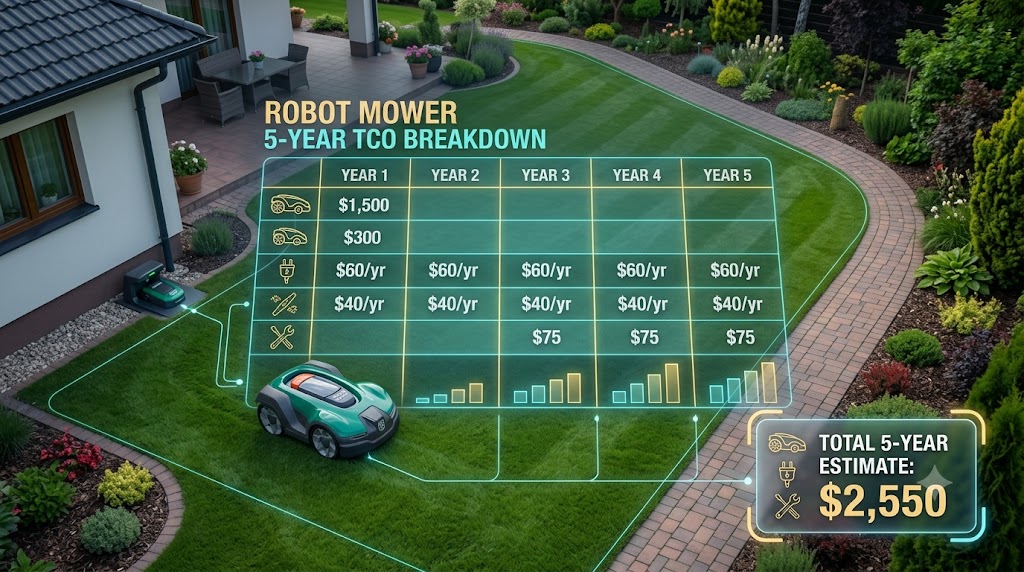
Putting it together: a 5-year cost model
| Category | 5-year cost (typical wire-based mid-size mower) |
|---|---|
| Purchase price | $1,000 to $2,500 |
| Installation (if hired out) | $0 to $500 |
| Electricity | $75 to $200 |
| Blades | $100 to $450 |
| Battery replacement (one, around year 3 to 4) | $100 to $400 |
| Maintenance and service | $0 to $500 |
| Estimated 5-year total | $1,275 to $4,550 |
The wide range reflects real variation in mower size, brand, and how much of the maintenance you do yourself versus pay someone else for. A budget mower for a small, flat, wire-friendly lawn lands toward the bottom. A premium GPS-equipped model for a larger property, plus a couple of professional service visits, lands toward the top.
How that compares to a gas mower over 5 years
A published 5-year cost comparison from robotic mower retailer Terramow put a mid-size robot mower’s total cost at roughly $4,000 (purchase plus blades, power, and one battery), against about $6,500 for a gas riding mower and roughly $14,500 for a zero-turn mower once purchase price, fuel, and maintenance are all factored in over the same period. Even a basic gas push mower, once you add fuel, oil changes, and the occasional tune-up, tends to land in the $500 to $700 per year range according to retailer cost estimates, which adds up to $2,500 to $3,500 over 5 years before counting your own time spent mowing.
There’s also a documented health and environmental angle worth factoring in, even if it doesn’t show up on a receipt. According to New Hampshire’s Department of Environmental Services, one hour of operating a new gasoline lawn mower emits as much volatile organic compounds and nitrogen oxide as driving a new car 45 miles. A robot mower, running on battery power charged at typical U.S. household rates, doesn’t carry that cost at all.
What resale value actually looks like at year 5
This is the part of the cost equation with the least solid public data. Robot mowers don’t have an established blue book the way riding mowers and cars do, and most used listings come from individual sellers on marketplaces like Facebook and eBay rather than dealers tracking depreciation curves.
What we can point to is real listed pricing from specialty resellers. Robotic Mower Services, a dealer that sells both new and refurbished Automower units, has listed the Automower 315X at a sale price of roughly $1,000 against an original MSRP of $1,800, a difference that reflects both age and refurbishment discounting rather than a formal depreciation study. Treat any resale figure for a robot mower as a rough estimate rather than a fixed rule. Condition, remaining battery life, and whether the boundary wire and charging station are included with the sale all move the number more than age alone.
The practical takeaway is that a well-maintained robot mower likely retains some resale value at year 5, similar to other outdoor power equipment, but you shouldn’t count on recovering a large share of the purchase price the way you might with, say, a well-kept riding mower from a brand with strong resale demand.
Where the money actually goes over 5 years
If you’re weighing whether a robot mower is worth the upfront cost, the honest answer is that the purchase price does almost all the work in the total. Electricity is close to a rounding error. Blades are a small, predictable recurring cost. The one expense worth planning for ahead of time is a battery replacement somewhere around year 3 or 4, since it’s the single largest cost after the mower itself.
If you’re shopping for a mower and want to keep the 5-year number down, a wire-based mid-range model sized correctly for your actual lawn, paired with doing your own blade changes and basic cleaning, keeps you toward the lower end of the range without giving up much in day-to-day performance. The Husqvarna Automower 115H 4G is a reasonable example of that lower-cost tier for yards up to 0.4 acres.
As an Amazon Associate, this site earns from qualifying purchases. Prices and specs change, so check the current listing before buying.
The bottom line
A robot mower’s 5-year total cost lands somewhere between $1,300 and $4,500 for most residential setups, with the purchase price doing most of the heavy lifting and electricity barely registering. Budget for one battery replacement around year 3 or 4, keep blade changes on a regular schedule, and skip professional servicing if you’re comfortable doing basic maintenance yourself. Against a comparable gas mower’s fuel and upkeep costs over the same period, the robot mower usually comes out ahead, even before counting the hours of mowing time you get back.
FAQ
What is the total cost of owning a robot lawn mower for 5 years? Most residential wire-based robot mowers cost between $1,300 and $4,500 over 5 years total, including the purchase price, electricity, blades, one battery replacement, and occasional maintenance.
How much does electricity cost to run a robot mower per year? Typically $15 to $40 a year for most residential mowers, based on average consumption of 0.5 to 2 kWh per week and the 2026 EIA forecast average U.S. residential rate of about 18 cents per kWh.
How often do robot mower blades need to be replaced? Most manufacturers recommend replacing blades every 2 to 3 months during active mowing season, which usually works out to 2 to 4 blade sets per year.
How much does it cost to replace robot mower blades? A replacement blade set typically costs $10 to $30, putting annual blade costs at roughly $20 to $90 for most owners.
How long does a robot mower battery last, and what does replacement cost? Batteries generally last 3 to 5 years before capacity drops noticeably, and replacements cost $100 to $400 depending on the mower’s voltage and battery size.
Is a robot mower cheaper than a gas mower over 5 years? Generally yes. Published cost comparisons put a mid-size robot mower’s 5-year total around $4,000, compared to roughly $6,500 for a gas riding mower and about $2,500 to $3,500 for a basic gas push mower once fuel and upkeep are included.
What is the running cost of a Husqvarna Automower per year? Running costs (electricity, blades, and occasional maintenance, excluding the purchase price) typically fall in the $50 to $150 per year range for most Automower models, based on published cost breakdowns for robot mowers generally.
Do robot mowers hold their resale value after 5 years? There’s no established resale market data specific to robot mowers the way there is for riding mowers. Listed prices at specialty resellers suggest used units can retain a meaningful share of their original value, but condition and remaining battery life matter more than age alone.
Is robot mower maintenance expensive compared to a gas mower? No. Robot mowers skip oil changes, spark plugs, and fuel system maintenance entirely. Most owners spend little beyond blade replacements and occasional cleaning, unless they choose to pay for annual professional servicing.
What’s the biggest cost in a robot mower’s total cost of ownership? The purchase price itself, by a wide margin. Everything else (electricity, blades, one battery replacement, and maintenance) typically adds up to a few hundred dollars a year at most.